Community Energy Bank
A Community Energy Bank is not a deposit-taking bank, investment product, speculative token system, guaranteed-return product, or regulated settlement service. It is a governed shared-capacity operating model for physical storage assets.
Governance Layer
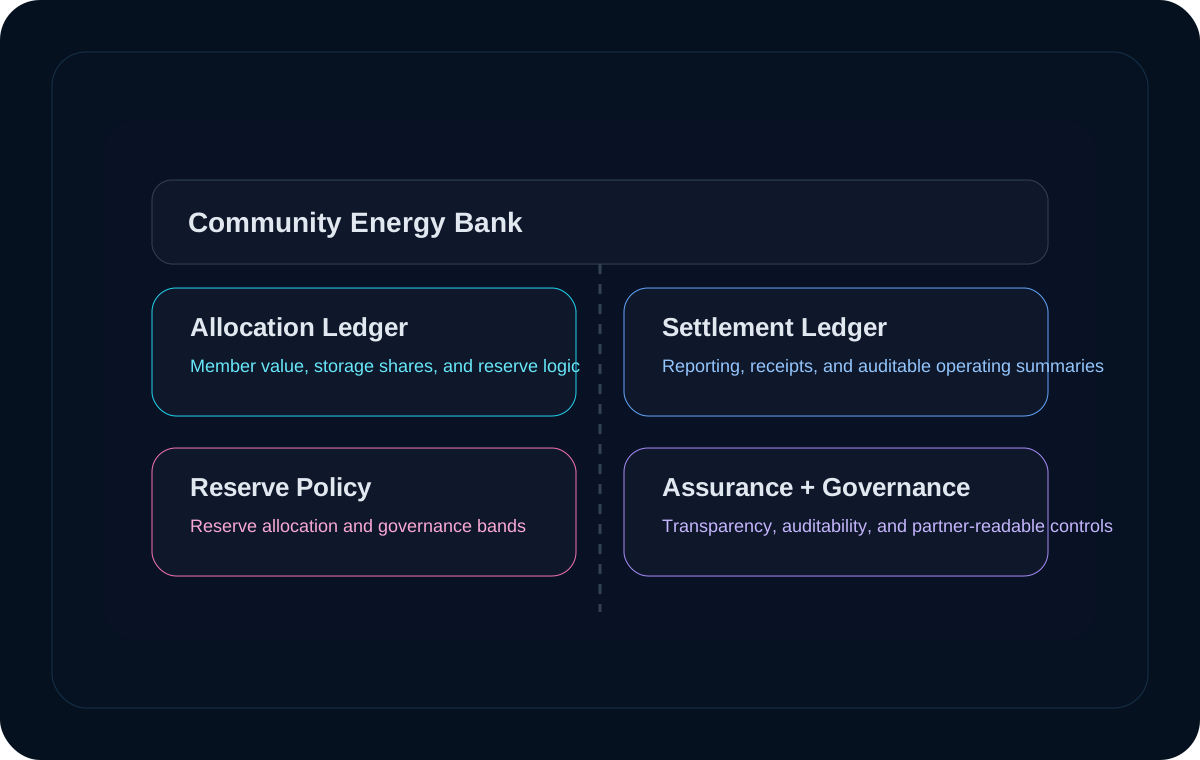
Community Energy Bank should look like an operating and governance framework, not a token panel
Visual hierarchy here should clarify allocation, reserve, settlement, reporting, and assurance layers for municipalities, communities, and portfolio operators.
Audience
Detail Focus
Scope Note
Review First
Start With
Start with the definition layer, then move into the Bulgaria regional context, representative scenario, readiness routes, or bounded intake only when the project question becomes concrete.
Jump To Section
Seven-Ledger Model
Non-Banking Boundary
A Community Energy Bank is not a deposit-taking bank, investment product, speculative token system, guaranteed-return product, or regulated settlement service. CitizenSolar uses the term to describe a governed shared-capacity operating model for physical storage assets.
- • Physical storage capacity is not currency.
- • Reserve rights are not bank deposits or securities.
- • Allocation reporting is not a guarantee of yield, savings, or revenue.
- • Governance visibility does not imply licensed financial services.
The Physical Problem
The model exists for shared physical storage questions that ordinary project pages do not resolve cleanly: who owns the asset, what capacity is usable, what reserve must stay protected, which events count as dispatch, and how shared use can be reviewed without collapsing into speculative language.
- • Shared storage requires asset, capacity, reserve, and event clarity.
- • Critical-load and continuity needs must stay visible before allocation logic is trusted.
- • Evidence, telemetry, and governance matter as much as hardware selection.
Seven-Ledger Model
CitizenSolar keeps the public model at seven canonical ledgers so visitors can understand what is being recorded, why it matters, what evidence would support it, and what it still does not prove.
- • Asset Ledger: Records infrastructure. Batteries, controllers, participating sites.
- • Capacity Ledger: Records usable capability. Available kWh, reserve windows, operating constraints.
- • Reserve Policy Ledger: Records rules. What stays protected, when dispatch is allowed, how reserve is prioritized.
- • Dispatch / Event Ledger: Records activity. Usage events, status changes, operating history.
- • Allocation Report Ledger: Records distribution. Non-speculative internal usage and allocation reporting records.
- • Assurance Ledger: Records evidence. Telemetry, signatures, audits, provenance, review trails.
- • Governance Ledger: Records decisions. Policy changes, approvals, member/community/partner oversight.
How It Works
The operating sequence starts with the physical asset and only grows into governance and reporting after capacity, reserve, usage, and assurance are clear.
- • Identify the physical asset.
- • Establish usable and protected capacity.
- • Define participant and authority roles.
- • Define reserve and allocation rules.
- • Record usage and dispatch events.
- • Record maintenance and assurance evidence.
- • Govern exceptions, disputes, and changes.
Participant And Authority Roles
A Community Energy Bank depends on visible role separation. Site authority, technical review, governance oversight, dispute handling, maintenance responsibility, and public-disclosure permission cannot stay implicit.
- • Authorized site representative
- • Site operator or facilities lead
- • Qualified electrical reviewer
- • Maintenance responsibility
- • Governance and dispute path
- • Bounded public-disclosure authority
Before Any Pilot
These are readiness requirements, not proof that a project is approved or operational.
- • identified site
- • authorized site representative
- • qualified electrical review
- • fire and safety review
- • capacity basis
- • critical-load inventory
- • maintenance responsibility
- • metering / telemetry basis
- • governance and dispute path
- • bounded public-claim permission
Deployment-Context Choices
The model can apply to several deployment classes, but the correct class only becomes credible after site and authority evidence is reviewed.
- • Municipal or public-building continuity and resilience
- • Commercial or industrial backup and operational continuity
- • Energy-community shared capacity and governance
- • Campus or institutional coordination and resilience
- • Other or not-yet-classified storage context
Evidence And Review Requirements
CitizenSolar maps, classifies, structures, screens, records, and identifies evidence gaps. It does not approve sites, certify engineering, approve procurement, confirm interconnection, guarantee financing, guarantee savings, or declare a pilot operational without evidence.
- • Authority, site, and disclosure permissions must be reviewable.
- • Capacity, reserve, telemetry, and maintenance assumptions need evidence.
- • Procurement, supplier, engineering, and safety reviews stay external.
- • Unknowns remain unknown until they are supported.
Representative Scenario Links
Use the public scenario layer to see how CitizenSolar structures readiness review without claiming that a live customer or pilot already exists.
Bulgaria Municipal CEB Case Study Skeleton
Representative scenario for a municipal or public-building readiness path.
Case Study Skeletons
Compare the Bulgaria CEB scenario with other regional storage-first scenarios.
Bulgaria Energy System Pack Mapping
Move from the concept page into the Bulgaria regional context layer.
Audience Entry Points
Choose the review path that matches the first real question, not the broadest marketing category.
- • For municipalities and public-building authorities: review authority, procurement, public-benefit, critical-load, engineering, safety, and disclosure requirements before any pilot decision.
- • For commercial and industrial sites: review operational continuity, load profile, critical-load, asset, capacity, maintenance, and orchestration evidence.
- • For energy communities and cooperatives: review participant authority, shared capacity, reserve protection, allocation reporting, assurance, governance, and dispute handling.
- • For engineers and technical reviewers: review physical assumptions, evidence levels, control boundaries, capacity support, telemetry, safety, and claim limits.
Readiness Paths
The safest next move is to pick one bounded review path and continue from there.
Review a Representative Scenario
See the Bulgaria representative evidence path.
Review Readiness Requirements
Check technical, evidence, and control-boundary requirements.
Review Public-Sector Readiness
Check procurement-neutral public-sector readiness requirements.
Check Finance-Fit Inputs
Open the bounded intake route.
Bounded Final CTA
Use a bounded inquiry or intake only when the project context is concrete enough to describe the site class, authority path, evidence state, and next review question.
Related Routes
Storage Bank
StorageStorage-first operating model and CitizenVault tiers.
Community Bank Portal
PortalPortal for policy, reporting, and governance workflows.
Community Energy Bank Overview Brief
BriefConcise shared-storage governance and operating-ledger summary.
CitizenVault Community
ProductShared-storage hardware tier aligned with the ledger model.
Bulgaria Energy System Pack Mapping
RegionsScenario-based Bulgaria mapping surface for municipal, C&I, and energy-community contexts.
Bulgaria Municipal CEB Case Study Skeleton
ScenarioRepresentative Bulgaria scenario showing the review structure without exposing internal node state.
Energy System Packs
FinanceFinance-aware storage-first pack architecture for shared-storage and public-benefit deployment paths.
Finance-Fit Energy System Review
FinanceFor buyers and partners that need grant, loan, tax-credit, lease, or public-funding readiness, CitizenSolar maps storage-first projects into finance-aware Energy System Packs.
Finance-Fit Intake
IntakeStructured qualification route for shared-storage purpose, governance, beneficiary evidence, and reporting readiness.
Five-Score Pack Screening
ScreeningPublic readiness-classification model for provider fit, sovereign stack, finance fit, orchestration readiness, and Community Energy Bank readiness.
Agentic Grid Orchestration
SoftwareDeterministic orchestration doctrine linking storage, reserve policy, and audit-ready operator workflows.
Orchestration Readiness Review
ServiceTranslate shared-storage governance and telemetry posture into a fixed-scope readiness assessment.
Orchestration Partners
PartnersPartner route for municipalities, OEMs, utilities, EPCs, and strategic collaborators.
Recommended Next Action